Constellation mythsST-01
The myth of Orion made simple: the scorpion, Artemis, and what Japan and China called the same stars


The myth of Orion tells how a hunter died and became stars. The story of his death has several versions, and Japan and China gave the same stars quite different names.
At a glance
This article walks through 13 topics, in this order.
- In short, what is the myth of Orion?
- How would you tell the Orion myth to a child?
- Who was Orion in the myth?
- Who sent the scorpion in the Orion myth?
- What did Artemis and Apollo do in the Orion myth?
- What are Orion's stars called, and what do the names mean?
…and 7 more in the contents below.
In this article (13 sections)
- In short, what is the myth of Orion?
- How would you tell the Orion myth to a child?
Who was Orion in the myth?1
Who sent the scorpion in the Orion myth?1
What did Artemis and Apollo do in the Orion myth?2
- What are Orion's stars called, and what do the names mean?
What is Orion called in Japan? What are Tsuzumi-boshi, Genji-boshi and Heike-boshi?2
What is Orion called in China? What is Shen (参宿)?1
How do the Ainu and people in the Southern Hemisphere see Orion?3
- How do the names for the same stars differ by region?
- How can you look at Orion while remembering the myth?
- Sources
The myth of Orion is the story of a Greek hunter who was placed among the stars. Orion is one of the most striking constellations of the winter sky, so many stories have gathered around it.
Yet Orion does not die in just one way. In some stories a scorpion stings him. In others he is hit by an arrow from the goddess Artemis.
People in Japan and China, meanwhile, saw the very same stars as something else entirely.
In this article you will find:
- The outline of the Orion myth, including a short version for children
- Who sent the scorpion, and how the versions differ
- Why Orion and Scorpius are never seen together
- The story of Artemis and Apollo, and Orion chasing the Pleiades
- What the star names mean, and Japanese names such as Tsuzumi-boshi, Genji-boshi and Heike-boshi
- The Chinese mansion Shen (参宿), and names used by the Ainu, in Aboriginal Australia and by the Maori
The key point is this: the myth of Orion is more fun to read if you ask "who told it, and where?" rather than "which version is right?"
In short, what is the myth of Orion?
The myth of Orion tells how Orion, a boastful hunter, died and was turned into a constellation by the gods.
The reason he died depends on the ancient source. Broadly, there are two families of stories.
- Killed by a scorpion: a scorpion sent by Gaia, the Earth goddess, or by Artemis stings him
- Killed by an arrow: an arrow from Artemis hits him, and in one version her brother Apollo tricks her into shooting
In both families Orion ends up in the sky. In the scorpion stories, the scorpion becomes a constellation too.
In the ancient texts, the scorpion is sent by Gaia (the Earth) or by Artemis. Some modern Japanese retellings name Hera instead.

It is normal for the Orion story to change from book to book. When you spot a difference, try checking which ancient author it comes from.
How would you tell the Orion myth to a child?
For children, the myth of Orion is "the story of a hunter who bragged too much and lost to a tiny scorpion."
Long ago in Greece there lived a huge, strong hunter called Orion. Orion boasted, "I will hunt down every animal in the world."
The Earth goddess heard him and grew angry, so she sent a single scorpion. The scorpion stung Orion, and Orion died.
Zeus, the king of the gods, put both Orion and the scorpion into the night sky.
Even now, when Scorpius rises in the east, Orion sinks in the west. People say Orion is still running away from the scorpion.
When you tell this story to a child, look for Orion in winter and Scorpius in summer together. It makes the story feel real.
Who was Orion in the myth?
In the myth of Orion, Orion is a giant hunter, said to be a son of the sea god Poseidon.
Orion already appears in Homer's *Odyssey*. In the land of the dead he is shown with a club, still driving wild beasts before him.
He is usually remembered less as a hero and more as a rough, boastful figure.
How did Orion lose his sight?
The myth of Orion also includes a story in which Orion is blinded and later healed.
In a version attributed to Hesiod, Orion got drunk on the island of Chios. He then assaulted Merope, the daughter of King Oenopion. The furious king put out Orion's eyes.
Orion went to the forge of Hephaestus, the smith god. There he lifted a boy named Kedalion onto his shoulders and had him guide the way east.
At the eastern edge of the world, the rays of the sun god Helios restored his sight, the story says.
Who sent the scorpion in the Orion myth?
In the ancient sources, the scorpion in the Orion myth is sent either by Gaia, the Earth goddess, or by Artemis, goddess of the moon and the hunt.
The Gaia version is the best known. Orion boasted that he would kill every beast on earth, so the Earth, angered, brought forth a scorpion.
This version is found in the star book that goes under the name of Eratosthenes, and in Hyginus's *Astronomica*. The Roman poet Ovid also writes that the Earth sent the scorpion.
The Artemis version comes from the poet Aratus, in his *Phaenomena*. While hunting, Orion seized the robe of Artemis, so the goddess sent the scorpion against him.
Some Japanese guides to the constellations say that Hera sent the scorpion.
We checked the Theoi Project, which collects English translations of the ancient texts. It does not name Hera as the one who sent the scorpion. The Hera version may have spread through later retellings.
Why are Orion and Scorpius never seen together?
Orion and Scorpius sit on almost opposite sides of the sky, so you will hardly ever see both of them high up at the same time.
Seen from Japan, Orion is a constellation of winter nights. Scorpius belongs to summer nights.
The two lie nearly half a circle apart around the sky. When one is high, the other is below the horizon.
The myth turns this pattern in the sky into a story. Hyginus writes that the stars were arranged so that Orion sets when the Scorpion rises.
Aratus, too, describes Orion fleeing to the western edge of the sky as the Scorpion comes up in the east.
For the story from the scorpion's side, and what Scorpius is called in Japan and the Pacific, see the myth of Scorpius.
Antares, the brightest star in Scorpius, is red. Comparing red Betelgeuse in winter with red Antares in summer is a nice way to link the two seasons.
What did Artemis and Apollo do in the Orion myth?
In another version of the myth of Orion, Artemis loves Orion, and a trick by her brother Apollo makes her shoot him with her own arrow.
Hyginus records this story in his *Astronomica*, citing a writer named Istrus.
Artemis loved Orion and was thinking of marrying him. Her brother Apollo did not like it.
Apollo pointed to a small dark shape far out at sea. "I bet you can't hit that," he said, goading his sister.
The arrow Artemis shot struck the dark shape. It was the head of Orion, who was swimming in the sea.
In her grief, Artemis placed Orion among the stars, the story goes. In Japan this version is often told as a sad love story, linked with Artemis as goddess of the moon.
Are there other stories of Artemis shooting Orion?
Yes. The myth of Orion has several other stories in which Artemis shoots him.
Apollodorus, in the *Bibliotheca*, gives two of them. In one, Orion challenged Artemis to a contest at throwing the discus.
In the other, Orion tried to assault a maiden named Opis, and Artemis shot him.
In Homer's *Odyssey*, Eos, the goddess of dawn, loved Orion and the gods resented it. Orion was then killed by the arrows of Artemis.
Here are the main versions of the Orion myth in one table.
| Version | What killed Orion | Why | Ancient source |
|---|---|---|---|
| Scorpion story (1) | A scorpion sent by Gaia, the Earth | He boasted he would kill every beast on earth | Hesiod (quoted in the star book under Eratosthenes' name), Hyginus *Astronomica*, Ovid *Fasti* |
| Scorpion story (2) | A scorpion sent by Artemis | He seized Artemis's robe on Chios | Aratus *Phaenomena* |
| Arrow story (1) | Artemis's arrow, after Apollo tricked her | Apollo disliked their closeness | Istrus (quoted in Hyginus *Astronomica*) |
| Arrow story (2) | Artemis's arrow | He challenged her at the discus, or tried to assault the maiden Opis | Apollodorus *Bibliotheca* |
| Dawn goddess story | Artemis's arrow | Eos loved him and the gods were jealous | Homer *Odyssey* |
How is the Orion myth linked to the Pleiades in Taurus?
The myth of Orion also includes a story in which Orion chases the sisters of the Pleiades.
According to Hyginus, Orion attacked Pleione, the sisters' mother, and pursued them for seven years. The king of the gods turned the sisters into stars, and Orion still seems to follow them.
The Pleiades, called Subaru (すばる) in Japan, are a star cluster near the shoulder of Taurus. They lie west of Orion, so they rise first and set first.
Every night the sky replays the chase: the Pleiades run, and Orion follows. Hesiod's *Works and Days* also describes the Pleiades plunging into the sea to escape Orion's strength.
What are Orion's stars called, and what do the names mean?
| Star | Bayer | Magnitude | Part of the hunter | Japanese name | Chinese name |
|---|---|---|---|---|---|
| Betelgeuse | α | 0.4 (variable) | Right shoulder (armpit) | Heike-boshi (Heike star) | Shen su si (参宿四) |
| Rigel | β | 0.1 | Left foot | Genji-boshi (Genji star) | Shen su qi (参宿七) |
| Bellatrix | γ | 1.6 | Left shoulder | (no widely known Japanese name) | Shen su wu (参宿五) |
| Alnitak | ζ | 1.8 | Belt (east end) | One of the Mitsuboshi (three stars) | Shen su yi (参宿一) |
| Alnilam | ε | 1.7 | Belt (middle) | One of the Mitsuboshi (three stars) | Shen su er (参宿二) |
| Mintaka | δ | 2.4 | Belt (west end) | One of the Mitsuboshi (three stars) | Shen su san (参宿三) |
| Saiph | κ | 2.1 | Right knee | (no widely known Japanese name) | Shen su liu (参宿六) |
Source: SIMBAD (CDS Strasbourg), V magnitude
Orion has two first-magnitude stars and five second-magnitude stars. In the table, a smaller number means a brighter star. Betelgeuse changes in brightness.
Most of the star names come from Arabic. Betelgeuse is explained as meaning "armpit" and Rigel as "foot".

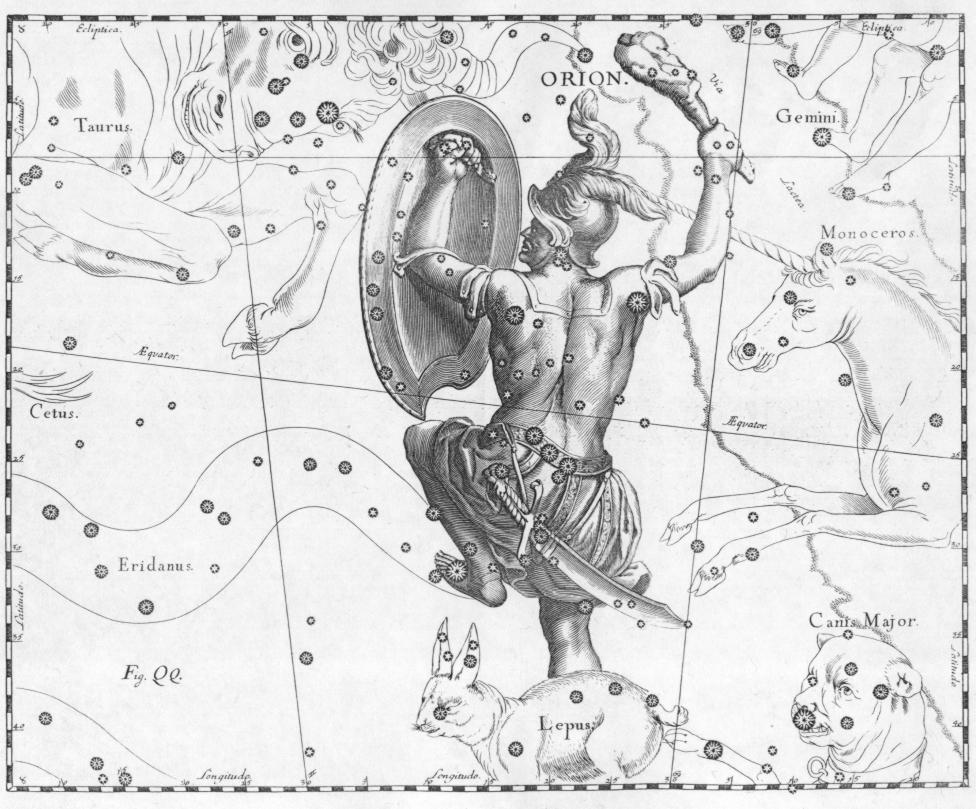
Red Betelgeuse marks the hunter's right shoulder, and blue-white Rigel his left foot. Between them, three stars of almost the same brightness sit in a straight, slanting row. These are the three belt stars, the hunter's belt.
Below the belt, three fainter stars hang in a line. This is the hunter's sword, and in its middle lies the Orion Nebula (M42).
What is Orion called in Japan? What are Tsuzumi-boshi, Genji-boshi and Heike-boshi?
The best-known traditional Japanese name for Orion is Tsuzumi-boshi (つづみ星), which compares the constellation's shape to a hand drum.
Watanabe Junichi of the National Astronomical Observatory of Japan describes it in a column. Orion was likened to the tsuzumi (鼓), a Japanese hand drum, and called Tsuzumi-boshi or similar names.
The shape pinches in at the belt and opens out above and below, which is said to resemble the body of the drum.
Which star is Heike-boshi, and which is Genji-boshi?
In Orion, Heike-boshi (平家星) is red Betelgeuse and Genji-boshi (源氏星) is white Rigel.
The colours are said to come from the Genpei War, in which the Heike (Taira) clan flew red banners and the Genji (Minamoto) clan flew white ones. The two stars seem to glare at each other across the belt.
Watanabe's column says these names were used "in some regions." A source from Toyama Prefecture also notes that the old names Heike-boshi and Genji-boshi were known there.
Heike-boshi and Genji-boshi make the difference in star colour easy to see. You can tell red from blue-white with the naked eye, no binoculars needed.
What local names do the three belt stars have in Japan?
Many local names for Orion's belt survive in Japan, often taken from everyday tools.
Nojiri Hoei, who collected Japanese star names, mentioned the belt in one of his letters. In Gunma and Fukushima, he wrote, it was called Santai-boshi (サンタイボシ).
In Toyama Prefecture, Masuda Masayuki surveyed the star names used around the prefecture and published them as a long series, *Etchu no Hoshi Monogatari* (越中の星ものがたり). The table shows the names for the belt from that work.
| Name | Stars | Where it was used | What it was compared to |
|---|---|---|---|
| Santai-boshi (サンタイボシ) | The three belt stars | Gunma and Fukushima prefectures | Three stars |
| Karatsuki-boshi (カラツキボシ) | Belt and sword stars together | Nadaura, Himi City, Toyama. Also Yoichi in Hokkaido, Niigata, Fukui and the Oki Islands in Shimane | The karasuki (からすき), a plough for tilling fields |
| Taketsugi-boshi (タケツギボシ) | The three belt stars | Funami, Nyuzen Town, Toyama | (not explained in the source) |
| Sao-boshi (サオボシ) | The three belt stars | Kosugi, Imizu City, Toyama | A pole |
| Heike-boshi and Genji-boshi (ヘイケボシ・ゲンジボシ) | Betelgeuse and Rigel | Toyama and many other places | The red Heike banner and the white Genji banner |
Karatsuki-boshi was recorded in Himi City in 1979 by the astronomy club of the University of Toyama. If you see the belt as the handle and the sword stars as the blade, the shape becomes a karasuki plough.
Japanese star names were used by people working in fields and at sea to tell the time and the season. The same belt stars looked like a plough to farmers, and like something else in other places.
For Japanese names of other stars, season by season, see our list of traditional Japanese star names.
What is Orion called in China? What is Shen (参宿)?
In the Chinese system of constellations, the main stars of Orion form the mansion called Shen (参宿, shen su).
China used its own system of constellations, separate from the Greek one. A guide from the Osaka Science Museum says its history goes back at least 2,500 years.
Shen is one of the 28 lunar mansions, the 28 divisions of the sky along the path of the moon. Because it is one of these mansions, it is called Shen su.
Shen is made of seven stars: the three belt stars and the four stars around them. Unlike the Greek system, each star is named with a number.
- The belt stars, from east to west, are Shen 1, Shen 2 and Shen 3 (参宿一・二・三)
- Betelgeuse is Shen 4 (参宿四)
- Rigel is Shen 7 (参宿七)
The same numbers appear in the *Hoen Seizu* (方円星図), a star chart by Ishizaka Joken published in 1826. That chart was based on the *Qinding Yixiang Kaocheng* (欽定儀象考成), a Qing dynasty star catalogue from 1752.
However, some scholars think the star numbers were not strictly fixed in earlier times.
Were the Chinese names used in Japan too?
Yes. From ancient times until the end of the Edo period, Japanese astronomers used the Chinese system of constellations.
The stars painted on the ceilings of the Takamatsuzuka and Kitora tombs in Nara Prefecture also follow the Chinese system.
Names like Tsuzumi-boshi and Genji-boshi belonged to daily life. Names like Shen su belonged to calendar making and astronomy. In Japan, star names were layered in two levels.
How do the Ainu and people in the Southern Hemisphere see Orion?
The Ainu and peoples of the Southern Hemisphere have also tied Orion's stars to their own lives and stories.
What do the Ainu call the three belt stars?
In Ainu tradition, the belt stars have been recorded as Iutani nochiu, "the pestle star."
According to Nojiri Hoei's article on Ainu star names, iutani means a pestle for pounding grain, and nochiu means star. The straight line of the three stars was probably seen as a pestle.
The same article also gives the name Reneshikur (レネシクル), collected by Kindaichi Kyosuke. It contains the word for "three people," and is said to picture three people lined up.
What story do the Yolngu of Australia tell?
The Yolngu people of northern Australia call Orion Djulpan. They see three brothers sitting in a canoe.
A paper by the astronomers Ray Norris and Duane Hamacher describes a version of the story recorded in 1973.
- The three belt stars are three brothers sitting in a canoe
- Betelgeuse is the front of the canoe and Rigel the back
- The Orion Nebula is a fish they caught, and the sword stars are the fishing line
One of the brothers ate a fish that he was forbidden to eat. Because of this, the Sun blew the three brothers, canoe and all, up into the sky, the story says.
In the Southern Hemisphere, Orion appears upside down compared with the view from Japan. A canoe may look more natural than a hunter there.
Is Rigel a New Year star for the Maori?
The Maori of New Zealand call Rigel Puanga. Some tribes have used it to mark the start of the new year.
According to the Maori dictionary, Puanga is the star seen above Tautoru, Orion's belt, in the eastern sky before dawn.
In New Zealand, the best-known New Year stars are the Pleiades, called Matariki. In some regions, though, the year is counted from Puanga instead of Matariki.
How do the names for the same stars differ by region?
| Stars | Greece and the West | Japan (traditional names) | China | Ainu | Australia (Yolngu) | New Zealand (Maori) |
|---|---|---|---|---|---|---|
| Orion as a whole | The hunter Orion | Tsuzumi-boshi (つづみ星) | Shen (main seven stars) | (no record confirmed) | Djulpan (canoe and three brothers) | (no record confirmed) |
| The three belt stars | The hunter's belt | Mitsuboshi (三つ星), Santai-boshi (サンタイボシ), Sao-boshi (サオボシ) | Shen 1, 2 and 3 | Iutani nochiu (pestle star) | Three brothers in a canoe | Tautoru |
| Betelgeuse | The hunter's right shoulder | Heike-boshi (平家星) | Shen 4 | (no record confirmed) | Front of the canoe | (no record confirmed) |
| Rigel | The hunter's left foot | Genji-boshi (源氏星) | Shen 7 | (no record confirmed) | Back of the canoe | Puanga (New Year star) |
| Sword stars and the Orion Nebula | The hunter's sword | Ko-mitsuboshi (小三つ星); with the belt, Karatsuki-boshi (カラツキボシ) | (not covered here) | (no record confirmed) | Fishing line and fish | (no record confirmed) |
As the table shows, the same three stars were seen as a belt, a pestle, brothers in a canoe and a plough.
"No record confirmed" means we could not check a source while writing this article. It does not mean that no name existed.
Three bright stars in an even, straight row seem to have caught the eye of people everywhere.
How can you look at Orion while remembering the myth?
From Japan, Orion is seen in the southern sky on winter nights. If you want to see the stars of the myth, start by finding the three belt stars.
Once you have the belt, the red star to the upper left is Betelgeuse (Heike-boshi). The blue-white star to the lower right is Rigel (Genji-boshi).
Follow the belt up to the right and you reach red Aldebaran and the Pleiades. Follow it down to the left and you reach Sirius, the brightest star in the night sky.
- The Pleiades: the sisters Orion is chasing
- Sirius: the first-magnitude star of Canis Major, and one corner of the Winter Triangle
- Gemini: the two bright stars side by side north of Betelgeuse, the brothers of the myth of Gemini
- Scorpius: not in the winter sky; look for it low in the south on summer nights
Somewhere away from city lights, you can also see the Orion Nebula glowing faintly among the sword stars below the belt.
Frequently asked questions about the Orion myth
Who killed Orion in the myth?
It depends on the version of the myth of Orion. In some, a scorpion sent by Gaia or Artemis kills him. In others, it is an arrow from Artemis.
Did Hera send the scorpion in the Orion myth?
In the ancient texts, the scorpion was sent by Gaia, the Earth goddess, or by Artemis. Hera appears in some modern retellings, such as Japanese guides.
Why can't Orion and Scorpius be seen at the same time?
The two constellations sit on almost opposite sides of the sky. The myth explains it by saying that Orion, afraid of the scorpion, is running away.
What is Orion's traditional Japanese name?
Tsuzumi-boshi, the hand-drum star, is the best known. In some regions Betelgeuse was called Heike-boshi and Rigel Genji-boshi.
What is Orion called in Chinese?
Its main seven stars form the mansion Shen (参宿). Betelgeuse is Shen 4 and Rigel is Shen 7.
When can you see Orion?
From Japan, Orion is easiest to see in the southern sky on winter nights. On summer nights it is near the sun and cannot be seen.
Sources
- Theoi Project, "Orion" (English translations of Hesiod, Aratus, Hyginus, Apollodorus, Homer and others)
- Theoi Project, "Pleiades" (Hyginus, Astronomica 2.21; Hesiod, Works and Days)
- Watanabe Junichi, "The winter king Orion: young blue-white stars" (Mitsubishi Electric DSPACE column, in Japanese)
- Honda, "Constellation guide: Orion" (supervised by AstroArts, in Japanese)
- Star names of Toyama (from Masuda Masayuki, Etchu no Hoshi Monogatari; Toyama science education material, in Japanese)
- Sakai Yoshito, "On Nojiri Hoei's letters about Japanese star names" (Kyoto University Research Information Repository, in Japanese)
- Kakazu Tsuguto, "Chinese names of stars" (Osaka Science Museum, Monthly Uchu, February 2021, in Japanese)
- Nojiri Hoei, "Star names in Ainu tradition, part 1" (Tenkai no. 242; Kyoto University Research Information Repository, in Japanese)
- Ray P. Norris and Duane W. Hamacher, "The Astronomy of Aboriginal Australia" (2009, arXiv:0906.0155)
- Te Aka Maori Dictionary, "Puanga"
- 1News, "Matariki or Puanga? Why location matters when marking the Maori New Year" (26 June 2024)
- SIMBAD (CDS Strasbourg): star brightness (V magnitude)
Read next
 Constellation mythsST-02The myth of Scorpius made simple: Orion's killer, Antares, and the fishhook seen from Japan to PolynesiaThe myth of Scorpius, version by version, with ancient sources. Why it never meets Orion, Japanese and Chinese names for Antares, and Maui's fishhook in the Pacific.
 Constellation mythsST-03The myth of Gemini made simple: how Pollux shared his immortality with Castor, and what Japan and China call the twin starsThe myth of Gemini version by version: who fathered the twins, how Castor died, and how Pollux shared his immortality. Plus Japanese, Chinese and Aboriginal names.