About this siteST-05
About Star Stories


Star Stories compares how the same stars have been named and told about in different places.
At a glance
This article walks through 7 topics, in this order.
- What kind of site is Star Stories?
- Where does the information come from?
- How are the myths and folklore written?
- Who is Kou?
- Photo credits
- Privacy
…and 1 more in the contents below.
In this article (7 sections)
What kind of site is Star Stories?
Star Stories is a hobby site for comparing constellation myths and the different names people have given to the same stars.
Greek myths about the constellations can be read in many books and websites. On this site we also put the traditional Japanese names of the same stars, the Chinese view of the sky, and stories from the Ainu and the Southern Hemisphere on the same page.
Where does the information come from?
Star Stories is written from English translations of the classics and from the materials of museums, science centres and observatories.
- Greek and Roman myths: English translations of Hesiod, Aratus, Hyginus, Ovid and others (collected by the Theoi Project)
- Japanese star names: the books and articles of Nojiri Hoei, and materials compiled by science museums and education bodies in each region
- Chinese stars: explanations by science museum curators and studies of Edo-period star charts
- Star brightness: the SIMBAD astronomical database
Each article ends with a "Sources" section that lists links to the materials we checked.
How are the myths and folklore written?
Star Stories does not pick one version of a story. We describe each version that has come down to us.
Myths change with the period and the writer. The death of Orion, for example, is told in several different ways.
- We write "the story goes that..." and "in another version..."
- Where possible, we say which ancient author tells each version
- For Japanese star names, we give the region when it is known. We leave out names whose origin is unclear
When something is not known, we say so. If new sources show a difference, we update the article.
Who is Kou?
Kou is the shoebill who guides you around this site. In the speech bubbles in each article, Kou gives quick tips on finding stars and on what to look out for.

Hello, I'm Kou. If you are in a hurry, try reading just my speech bubbles.
Photo credits
We only use photos and images from Wikimedia Commons that are free to use. The authors and licences are listed below.
| Photo | Author | License | |
|---|---|---|---|
 | Orion in the night sky, with red Betelgeuse, blue-white Rigel and the three belt stars | Mouser | CC BY-SA 3.0 |
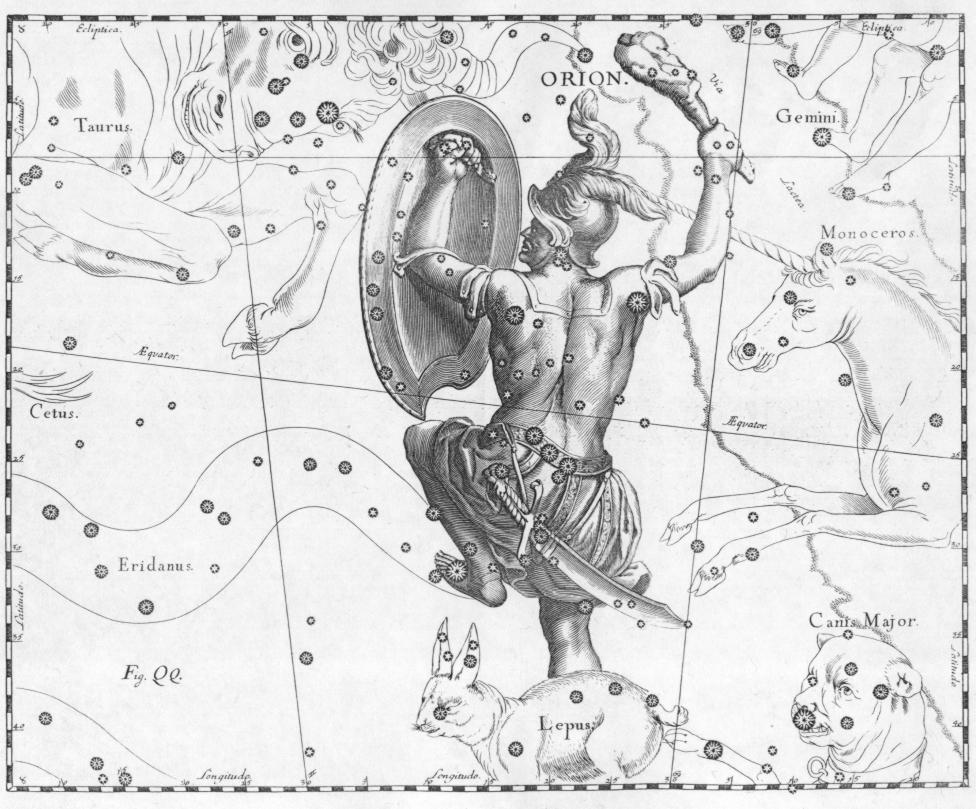 | The hunter Orion in Hevelius's star atlas (1690), drawn as seen from outside the celestial globe, so left and right are reversed | Johannes Hevelius | Public domain |
 | Scorpius on a card from Urania's Mirror (c. 1824), with Antares in the middle of the body and the tail curling up to the sting | Sidney Hall, Adam Cuerden | Public domain |
 | Scorpius on an 18th-century star chart, its tail curving like a fishhook inside the Milky Way (Via Lactea) | Corbinian Thomas | Public domain |
 | The Pleiades (Subaru): a tight group of blue-white stars wrapped in faint glowing gas | NASA, ESA, AURA/Caltech, Palomar Observatory | Public domain |
 | The Big Dipper above a mountain ridge, its seven stars forming the ladle | Caldwbr | CC0 |
 | Gemini on a card from Urania's Mirror (c. 1824): the twins stand side by side, with Castor and Pollux at their heads | Sidney Hall, Adam Cuerden | Public domain |
 | The twins of Gemini in Hevelius's star atlas (1690), drawn as seen from outside the celestial globe, so left and right are reversed | Johannes Hevelius | Public domain |
Privacy
Star Stories does not collect personal information. There is no contact form, membership registration or comment section.
We use Google Analytics (GA4) to learn which pages are read and from which countries. It uses cookies (small pieces of data that record browsing). We do not collect information that identifies you, such as your name or email address. See how Google uses data from sites that use its services.
Photos are loaded from the Wikimedia Commons servers. When this happens, your browser connects to the servers of the Wikimedia Foundation.
In the future, this site may show ads from Google AdSense. In that case, Google will use cookies (small pieces of data saved in your browser to record browsing) to show ads based on your browsing history. You can turn these ads off on Google's ad settings page. If we show ads, we will say so on this page.